At 5:21pm Eastern Time on 12 June, Anthropic received an export control directive from the US government, citing national security authorities, ordering the suspension of all access to Claude Fable 5 and Mythos 5 by any foreign national whether inside or outside the United States, including Anthropic's own foreign-born employees.

Unable to selectively enforce such a broad restriction in real time, Anthropic disabled both models for all customers globally, while confirming that all other Claude models remain unaffected.

The directive offered no specific detail on the underlying national security rationale. Officials indicated the decision followed the discovery of a technique to bypass Fable 5's safety guardrails, the same guardrails designed to prevent users accessing the advanced cybersecurity capabilities of Mythos 5, the underlying model on which Fable 5 is built.

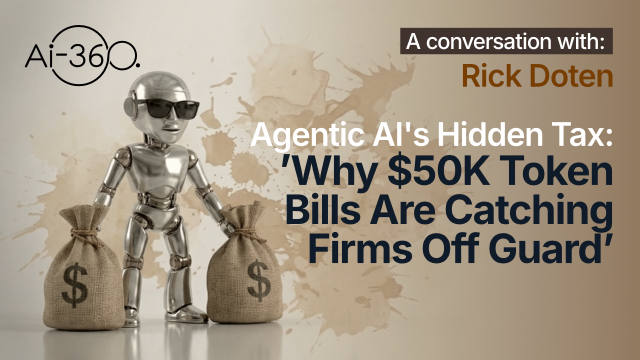
Agentic AI’s Hidden Tax: Why $50K Token Bills Are Catching Firms Off Guard
Are you prepared for the AI cost line that doesn’t yet appear on your budget? Rick Doten founded Prescient Cyber Risk earlier this year, and his first months advising boards, VC firms, and startups have surfaced a critical blind spot: agent token cost. Only 2% of the people he speaks with currently run agents in production— yet those who deploy without a token cost strategy are discovering monthly bills of $50,000 before anyone raises the alarm. Meanwhile, 90% of AI security is work organisations already know how to do. The gap is in what they’re not yet planning for. Speakers: Rick Doten, AI & Cybersecurity Advisor, Prescient Cyber Risk; interviewed by Stewart Tinson, Project Director, AI-360 at Newton Media. You’ll learn: • Why 90% of AI security is traditional cybersecurity—asset management, identity, data protection, and vulnerability management • How to manage agent token costs before they become an unplanned CFO problem • The 7-step automated remediation framework replacing manual security patching • Why AI enablement and AI governance are not the same thing—and how to sell the reframe internally • What VCs now require before funding AI security startups, and what it signals for enterprise buyers • How to structure board-level AI strategy around three questions: plan, compliance, and security Key topics: Agentic AI adoption • Agent token cost • AI governance frameworks • Automated remediation • AI enablement vs governance • Board AI strategy • VC investment dynamics • AI security startups • Third-party AI risk • Crowdsourced threat intelligence For CISOs, CIOs, CFOs, and enterprise risk leaders preparing for the shift from AI pilots to production in 2026.

Anthropic pushed back. The company said it reviewed what it believes to be the report behind the government's action and concluded that the level of capability demonstrated is already available from other publicly deployed models, including OpenAI's GPT-5.5, and is routinely used by cybersecurity defenders.

The timing is awkward. The shutdown came weeks after Anthropic disclosed a revenue run rate of $47 billion and closed a funding round valuing it at $965 billion, with a confidential IPO prospectus already filed with the SEC. Analysts expect the export control action to unsettle investors, raising questions about whether the company can remain at the cutting edge of AI development if its models remain subject to government restriction.

Anthropic said it believes the situation is a misunderstanding and is working to restore access.


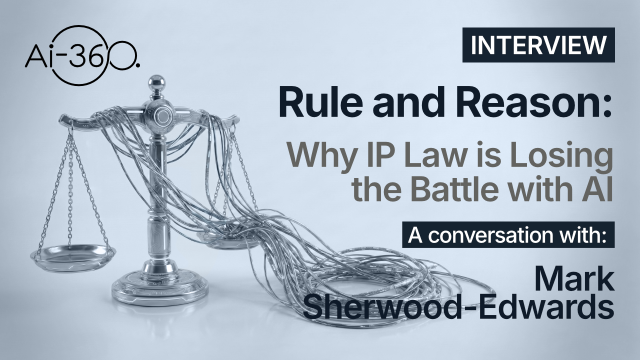
Rule and Reason: Why IP Law Is Losing the Battle with AI
Copyright law was built for a different world. Its rules were designed around physical property, cottage-scale copying and a clear dividing line between creator and creation. Artificial intelligence has torn up all three assumptions. Stewart Tinson speaks with Mark Sherwood-Edwards, technology lawyer and founder of Clearview Legal, about why the legal reasoning around intellectual property has become, in his word, incoherent — and why that matters to every enterprise deploying or building on AI today. They work through the landmark UK Getty Images vs Stability AI case, in which images complete with Getty watermarks were reproduced by a model trained without permission — yet no infringement was found. They examine why courts repeatedly confuse copyright with antitrust, why the EU Database Directive rewards inefficiency, and why the question of whether AI-generated work attracts copyright protection at all has produced a global split that creates real commercial risk for technology businesses. Mark’s argument, grounded in economic property theory rather than legal convention, is that copyright’s underlying purpose — protecting the investment in intellectual work so that it can be traded and exploited — is being systematically undermined. Not just by AI, but by decades of incoherent legal reasoning that conflates copying with ripping off, confuses market function with judicial assessment, and applies time-limited protection to non-rivalrous assets while granting perpetual rights to physical ones. For CLOs, general counsel, and technology executives navigating AI adoption, this is a session with real commercial edge: what are the actual IP risks when deploying AI tools, what should enterprise contracts say about data use and derived data, and where does the liability sit when an AI gives the wrong answer? Guests: Mark Sherwood-Edwards, Founder, Clearview Legal | Host: Stewart Tinson, AI-360 Online
Share this post
The link has been copied!