Salesforce and Anthropic have announced Claudeforce, an expanded partnership that embeds Claude's reasoning inside Salesforce's enterprise systems.

At launch is Salesforce in Claude, a plugin built around 37 prebuilt sales skills, among them meeting preparation, deal health checks and pipeline reviews, all executed as governed actions from within Claude itself. Behind it sits AIforce, Salesforce's enterprise harness, which routes Claude's access to a company's data and workflows through MCP servers, APIs and CLI tools.

The integration runs the other way too. Inside Salesforce, Claude now functions as the reasoning engine for Agentforce's Atlas system, and underpins Agentforce Vibes and Agentforce Coworker as standard. Via Amazon Bedrock, it will also sit inside the Salesforce Trust Boundary, a setup pitched at customers in regulated sectors.

Each company has adopted the other's tools internally: Salesforce now runs Claude as its default model across Slack and Slackbot, while Anthropic has made Salesforce its own CRM of choice.

Salesforce in Claude is currently live with a limited group of pilot customers, with a broader public beta scheduled for September 2026 and additional skills due later in the year.

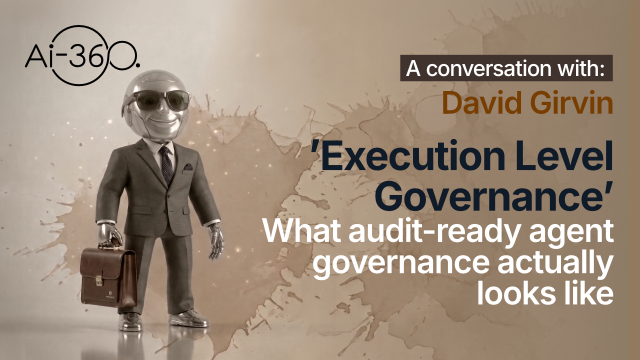
Execution Level Governance- What audit-ready agent governance actually looks like
David Girvin, founder and CEO of Assury argues that model-in-the-loop review, AI governing AI, is fundamentally unreliable for regulated environments: even the best-performing models miss a meaningful share of violations, the reviewing model is typically provided by the same vendor being reviewed, and prompt injection or context poisoning can compromise both the acting agent and its supposed overseer simultaneously. He makes the case for deterministic, architecturally enforced controls instead, walking through Assury’s approach of autonomy zones, session risk accumulation, and credential starvation, which lets a compromised agent be cut off from its tools instantly rather than relying on time-boxed access. The conversation touches on why David is sceptical of just-in-time credentialing as a solution for agent security more broadly, since agent sessions don’t run on predictable human timescales, along with the current gap between how identity and security vendors are pitching agent protection and what he sees happening at the execution layer in practice. He also discusses the compliance and audit implications of probabilistic decision-making, arguing that regulated industries will increasingly need tamper-evident, hash-chained audit trails that can withstand scrutiny from auditors and regulators who are only beginning to understand agentic risk, and reflects on a named frontier lab’s own published framework as an example of the gap between research and practitioner reality. Elsewhere, David reflects candidly on building a bootstrapped security company in an increasingly crowded market, why he turned down aggressive VC funding to stay in control of the product, and what a credible third-party assessment of his own gateway would need to look like given that Assury sits directly in the execution path for every customer’s agents.
Share this post
The link has been copied!