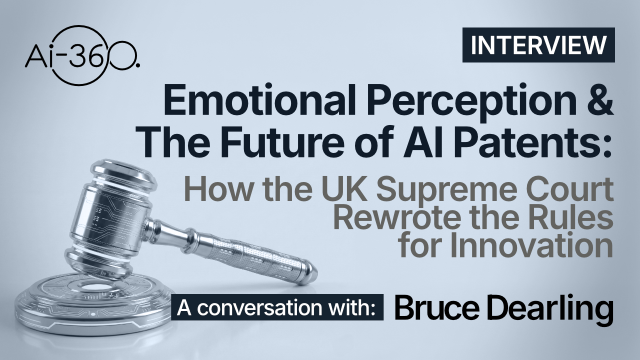


A UK Supreme Court ruling on AI patentability is expected to reshape how enterprises, startups and investors think about intellectual property strategy, particularly as AI systems become more central to enterprise value creation.
The decision, handed down on 11 February 2026 in Emotional Perception AI Limited v. Comptroller General of Patents, Designs and Trade Marks, overturns a legal framework that had shaped software patent decisions in the UK for nearly two decades and, according to Bruce Dearling, Partner at Hepworth Browne, the attorney behind the case, significantly lowers barriers for companies seeking protection for AI-related inventions.
During an AI-360 interview, Dearling described the ruling as both “future proofing technology” and “seismic,” arguing that it fundamentally resets how innovation is assessed. “It basically reframes the statutory requirements for patentability we’ve had for essentially 20 years,” he said.
More importantly, he argued, it aligns the UK more closely with international standards by moving away from what he described as a disproportionately restrictive domestic approach. “It fundamentally means that rights or acquisition of rights should be considerably easier,” he said. “One will not get blanket rejections from the UK patent office now.”
That shift addresses a long-standing frustration for software and AI companies operating in the UK. Under the earlier Aerotel test precedent, patent applications involving software were frequently dismissed before examiners properly assessed whether the underlying technology delivered a meaningful technical contribution.
Dearling argued that this framework had become increasingly outdated as modern computing evolved far beyond the assumptions embedded in legislation written decades ago, noting that at the time legislation was written, even cellular phones weren’t around. The Supreme Court ruling forces examiners to evaluate inventions in the context of how modern technology actually operates rather than applying broad exclusions to software-heavy claims. “They actually have to look at what invention means in the context of what you’re doing, what technology is, what all fields of technology are.”
One of the most commercially significant outcomes from the ruling is what Dearling described as the “any hardware” threshold. Under the court’s interpretation, if a patent claim explicitly includes hardware such as processors or computing infrastructure, it can overcome an important statutory exclusion that has historically blocked software patent claims. “If the claim which defines a legal monopoly recites a piece of hardware, a processor, that is all you need to overcome the statutory exclusion,” he said.
That does not mean AI patents will be approved more easily across the board. Inventions must be novel and create a genuine technical outcome. Patent examiners will still need to assess whether a company has introduced meaningful innovation rather than simply applying AI to existing workflows. He pointed to AI-driven loan approvals as an example of where businesses could still struggle, explaining that implementing a task using AI amounts to little more than automating an existing business process with established technology.
That distinction matters for enterprise AI leaders racing to commercialise generative AI and automation platforms. The ruling rewards technical differentiation rather than superficial AI adoption. Companies that simply attach machine learning models to existing workflows may still struggle to build defensible intellectual property positions, while businesses solving infrastructure, optimisation, deployment or architectural challenges could benefit from stronger protections.
Dearling repeatedly returned to the importance of examining how technical and non-technical features interact to create measurable real-world outcomes. “It forces you to look at the interaction between the features,” he said. For enterprise AI providers operating in crowded markets where product differentiation is increasingly difficult, stronger protection around proprietary infrastructure could become a meaningful competitive advantage.
The ruling also touched on a more controversial issue: whether artificial neural networks should be classified as computer programs. Dearling openly disagreed with the court’s reasoning here, arguing that trained neural networks function more like fixed technical systems than traditional software. While he challenged that aspect of the judgment, he acknowledged that the broader ruling represented a major correction to outdated legal assumptions about modern AI systems.
Beyond patent law, the ruling could also influence startup funding and broader AI competitiveness in the UK. Dearling argued that intellectual property protection remains critical for early-stage companies trying to attract capital, particularly when competing against larger incumbents. “In order for an SME to attract investment, they need to have something to placate their investor,” he said. “The only way of doing that is to have an IP right.” Without defensible IP, startups often struggle to demonstrate long-term commercial value. He cited research suggesting intellectual assets now account for 92% of company value and argued that stronger patent protections could materially improve startup valuations. “Anything that secures or makes life easier to secure those rights means that you have value added to your company.”
However, he argued that stronger patent protections alone will not solve the UK’s structural innovation challenges. Access to growth capital remains a far bigger issue. He criticised the scale of available public funding for UK startups and warned that promising AI businesses are still failing because they cannot secure sufficient early-stage investment. He contrasted that with the scale and accessibility of capital in US markets, where AI companies often scale faster because funding infrastructure is more mature.
The implications could extend well beyond the UK. Dearling said legal professionals and policymakers in New Zealand, China, Europe and the US are already watching the ruling closely because it may become one of the first major legal precedents addressing AI patentability at scale.
For enterprises building long-term AI strategies, the ruling reflects a broader shift taking place across global markets: as AI moves from experimentation into operational deployment, intellectual property strategy is becoming far more central to enterprise competitiveness, valuation and long-term market control.