OpenAI and Broadcom have unveiled Jalapeño, OpenAI's first custom designed AI accelerator and the opening step in what the two companies describe as a multi generation compute platform built specifically for large language model inference.

The chip was delivered to OpenAI CEO Sam Altman and President Greg Brockman by Broadcom President and CEO Hock Tan and President Charlie Kawwas. Rather than adapting general purpose AI hardware, OpenAI built Jalapeño from scratch around its understanding of LLM fundamentals, with Broadcom handling chip implementation and networking, and Celestica handling board, rack and system integration.

Engineering samples are already running production target workloads in the lab, including GPT‑5.3‑Codex‑Spark. Early testing suggests performance per watt substantially ahead of current state of the art hardware, though OpenAI says a full technical report will follow in coming months.


Who Owns AI Security in the Enterprise? Governance Is Still in Its Infancy
Who actually owns AI security in your organisation — and how mature is your governance around it? Two senior CISOs from vastly different environments give a straight answer: ownership sits with the CISO for now, and governance, even in well-run programmes, is still in its infancy. AI is shifting enterprise risk from defending infrastructure to defending decisions. Agentic AI operates semi- or fully autonomously, traditional security controls don’t fit probabilistic systems, and no single vendor covers the full attack surface. Speakers: Andy Holliday, CISO at Petrofac, Lester Godsey, CISO at Arizona State University and Stewart Tinson, Project Director, AI-360 You’ll learn: • Why the CISO is the only realistic owner of AI security risk for the next 5 years • Why agentic AI breaks deterministic security controls and what to do about it • How ASU built an actionable AI framework supporting 60+ large language models • Practical controls: API key hygiene, command whitelists, blast radius reduction • Why no single vendor can cover AI security end-to-end Key topics: Agentic AI risk • AI governance maturity • Threat model transformation • CISO ownership • Incident response for AI • Ethics & training data bias • Vendor landscape reality • Probabilistic vs deterministic controls For CISOs, CIOs, and risk leaders making decisions about AI adoption now.

The development timeline stands out. The chip went from initial design to manufacturing tape out in roughly nine months, which the companies call the fastest ASIC development cycle achieved in high performance semiconductors, partly accelerated by using OpenAI's own models in the design process.

Initial deployment is planned for the end of 2026, expanding in subsequent generations. Tan said the partnership would enable gigawatt scale data centre deployment with Microsoft and other partners beginning in 2026.

The announcement extends OpenAI's stated ambition to operate across its full stack, from products and models down to the chips that run them.

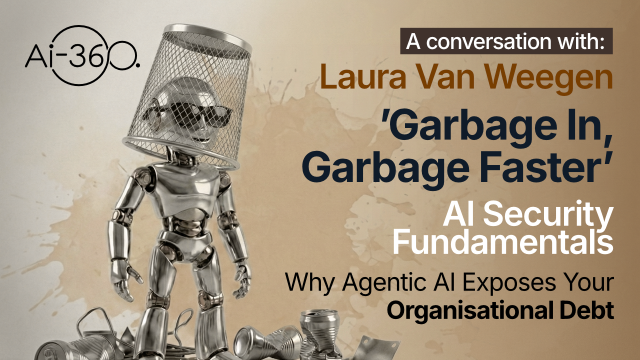
Garbage In, Garbage Faster: Why Agentic AI Exposes Your Organisational Debt
If Agentic AI follows your documented processes, what happens when those processes don’t reflect reality? Most organisations assume AI will figure things out. Business Architect Laura Van Weegen argues the opposite: AI doesn’t create new problems — it removes your ability to ignore the ones that have existed forever and a day. Undocumented workflows, undefined decision ownership, and human workarounds masking broken systems all get amplified at machine speed. You’ll learn: • Why “garbage in, garbage faster” is the real Agentic AI risk • The critical difference between feeding AI data versus information • How process debt compounds the same way technical debt does • Why exception handling is the new decision design priority • What one conversation reveals more than most AI readiness assessments • How to build explainability in from day one Key topics: Agentic AI readiness • Information architecture • Process debt • Data vs information • Contextual blindness • Decision ownership • Explainability vs traceability • Semantic infrastructure • Exception handling • Organisational accountability • Workflow documentation • AI governance Essential viewing for CISOs, CIOs, CFOs, and Chief Legal Officers evaluating Agentic AI deployment — before the human safety net disappears.

Share this post
The link has been copied!