Mistral AI has announced a raft of upgrades to its Connectors platform, aimed at giving enterprises tighter governance over how AI agents access third-party tools and data.

The headline additions include enriched admin controls for setting connector access per workspace, API keys with connector scopes to stop automated workloads impersonating users, multi-account connectors letting one login point hold several accounts, a debugging tool for diagnosing broken MCP connections, connector support inside Vibe Code, and connector support inside Workflows for long-running tasks. Most of these are now generally available, though the debugger and the Workflows integration remain in public preview.

The company's pitch centers on a common enterprise frustration: it's straightforward to wire up an agent to enterprise data for a demo, but keeping that connection stable and properly governed once it's running in production is a much harder problem. The new tool-level controls address part of that by letting admins approve or block individual actions within a connector, rather than granting or denying access to the whole thing, so a write or delete action can be switched off while the rest of the connector keeps working.

Mistral says its connector directory now covers more than 60 integrations, spanning categories from knowledge and data tools to developer platforms, with custom MCP connectors available to fill any remaining gaps.

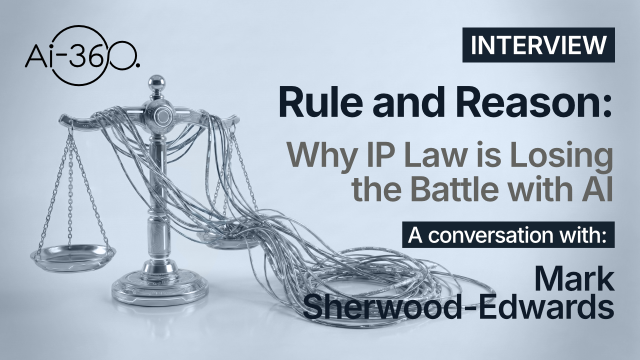
Rule and Reason: Why IP Law Is Losing the Battle with AI
Copyright law was built for a different world. Its rules were designed around physical property, cottage-scale copying and a clear dividing line between creator and creation. Artificial intelligence has torn up all three assumptions. Stewart Tinson speaks with Mark Sherwood-Edwards, technology lawyer and founder of Clearview Legal, about why the legal reasoning around intellectual property has become, in his word, incoherent — and why that matters to every enterprise deploying or building on AI today. They work through the landmark UK Getty Images vs Stability AI case, in which images complete with Getty watermarks were reproduced by a model trained without permission — yet no infringement was found. They examine why courts repeatedly confuse copyright with antitrust, why the EU Database Directive rewards inefficiency, and why the question of whether AI-generated work attracts copyright protection at all has produced a global split that creates real commercial risk for technology businesses. Mark’s argument, grounded in economic property theory rather than legal convention, is that copyright’s underlying purpose — protecting the investment in intellectual work so that it can be traded and exploited — is being systematically undermined. Not just by AI, but by decades of incoherent legal reasoning that conflates copying with ripping off, confuses market function with judicial assessment, and applies time-limited protection to non-rivalrous assets while granting perpetual rights to physical ones. For CLOs, general counsel, and technology executives navigating AI adoption, this is a session with real commercial edge: what are the actual IP risks when deploying AI tools, what should enterprise contracts say about data use and derived data, and where does the liability sit when an AI gives the wrong answer? Guests: Mark Sherwood-Edwards, Founder, Clearview Legal | Host: Stewart Tinson, AI-360 Online
Share this post
The link has been copied!