NVIDIA has announced a long-term strategic partnership with Safe Superintelligence Inc (SSI), the AI safety lab led by Ilya Sutskever, alongside a direct investment in the company.

The deal gives SSI access to NVIDIA's next-generation Vera Rubin computing platform, which the companies say will expand SSI's compute capacity by an order of magnitude. The two firms will also collaborate on technical development of NVIDIA's current and future compute platforms, drawing on SSI's research insights into the future of AI.

NVIDIA said it pursued the partnership after gaining rare access to SSI's closely guarded research, which the lab has been developing quietly for two years in pursuit of a robustly aligned superintelligence. Jensen Huang, NVIDIA's founder and chief executive, praised Sutskever's earlier breakthroughs, including his work on AlexNet.

Sutskever said the scale of NVIDIA's computing power would let SSI pursue research he described as "worthy of scaling up." Founded in 2024, SSI is backed by investors including Andreessen Horowitz, Sequoia Capital, DST Global and Greenoaks, and states its sole goal is building a safe superintelligence.

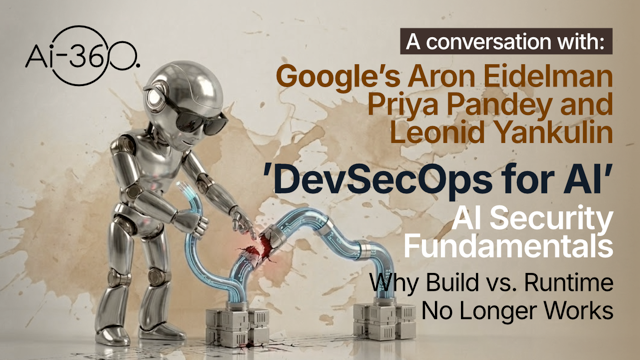
DevSecOps for AI: Why 90% Stays the Same—and the 10% That Changes Everything
Is your DevSecOps pipeline ready for AI—or just ready for the AI you tested last week? AI systems behave probabilistically. The same prompt injection attack can succeed 50 times in a row, then fail completely the next minute. Traditional shift-left testing was built for determinism. AI isn’t. That gap is where risk lives. Three members of Google’s security advocacy team break down what actually changes—and what doesn’t—when AI enters your DevSecOps pipeline. You’ll learn: • Why 90% of AI security is still traditional security—and exactly where the novel 10% creates new exposure • Why DevSecOps transformations fail within a year—and the top-down cultural shift that prevents it • How the latest DORA research shows AI agents amplify existing practices, good or bad, at scale • What AI runtime security (e.g., Model Armor) does that a WAF cannot • Why AI logs capturing PII and system instructions in plain text demand a new approach to observability Key topics: Non-determinism in AI testing • Continuous evaluation vs. pre-deployment scans • Model Armor & runtime security layers • Sensitive data redaction in logs • Prompt injection defense-in-depth • Agentic workload security • WAF limitations with AI agents • DevSecOps governance & top-down culture For CISOs, DevSecOps leads, and security architects navigating AI adoption: the pipeline you spent three years building is mostly still valid. This session tells you exactly what to add. All viewers will receive a c’heat sheet’ compiling links galore courtesy of Aron Eidelman.
Share this post
The link has been copied!