Anthropic chief executive Dario Amodei has issued a statement denying the company has ever advocated banning open-weights AI models.

Amodei said open-weights models without dangerous capabilities are a public good, but reiterated two long-standing national security concerns: that authoritarian governments could use superior AI for military dominance or repression, and that open models are harder to monitor or withdraw once released, raising cyberattack and bioweapon risks.

Rather than banning open models, Amodei said Anthropic supports three measures: restricting sales of advanced chips and chipmaking equipment to China, cracking down on large-scale "distillation" operations that let China narrow the AI gap despite chip restrictions, and mandatory safety testing for all sufficiently capable models regardless of origin or openness.

He said he agreed with parts of an industry letter backing open-weights models, including that open weights broaden access and strengthen competition, but disputed its claim that openness necessarily aids defenders more than attackers, citing biological risk as an area where he believes the reverse may be true.

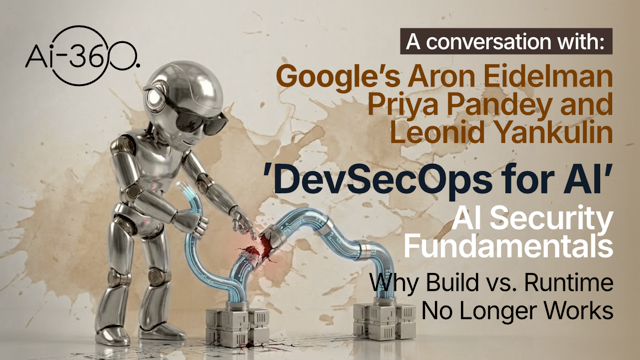
DevSecOps for AI: Why 90% Stays the Same—and the 10% That Changes Everything
Is your DevSecOps pipeline ready for AI—or just ready for the AI you tested last week? AI systems behave probabilistically. The same prompt injection attack can succeed 50 times in a row, then fail completely the next minute. Traditional shift-left testing was built for determinism. AI isn’t. That gap is where risk lives. Three members of Google’s security advocacy team break down what actually changes—and what doesn’t—when AI enters your DevSecOps pipeline. You’ll learn: • Why 90% of AI security is still traditional security—and exactly where the novel 10% creates new exposure • Why DevSecOps transformations fail within a year—and the top-down cultural shift that prevents it • How the latest DORA research shows AI agents amplify existing practices, good or bad, at scale • What AI runtime security (e.g., Model Armor) does that a WAF cannot • Why AI logs capturing PII and system instructions in plain text demand a new approach to observability Key topics: Non-determinism in AI testing • Continuous evaluation vs. pre-deployment scans • Model Armor & runtime security layers • Sensitive data redaction in logs • Prompt injection defense-in-depth • Agentic workload security • WAF limitations with AI agents • DevSecOps governance & top-down culture For CISOs, DevSecOps leads, and security architects navigating AI adoption: the pipeline you spent three years building is mostly still valid. This session tells you exactly what to add. All viewers will receive a c’heat sheet’ compiling links galore courtesy of Aron Eidelman.
Share this post
The link has been copied!