OpenAI has announced price cuts across its GPT-5.6 model family, alongside a new Fast mode for its top-tier Sol model in the API.

From yesterday, GPT-5.6 Luna, described as the company's fastest and most affordable model, will cost 80% less, while Terra, its balanced everyday model, will cost 20% less. New API pricing sets Terra at $2 per million input tokens and $12 per million output tokens, and Luna at $0.20 per million input tokens and $1.20 per million output tokens. Sol's pricing is unchanged.

OpenAI said the changes reflect broader efficiency gains across its models, inference systems and agentic tooling, citing internal use of Sol to autonomously rewrite production kernels and run optimisation experiments, cutting model-serving costs by 20% and improving token-generation efficiency by more than 15%.

Fast mode for Sol replaces the previous Priority Processing offering, delivering up to 2.5 times the speed of standard processing at twice the price, with existing priority-tagged requests continuing to work automatically.

Terra and Luna remain available across ChatGPT Work, Codex and the OpenAI API, with subscription prices and quota budgets unchanged.

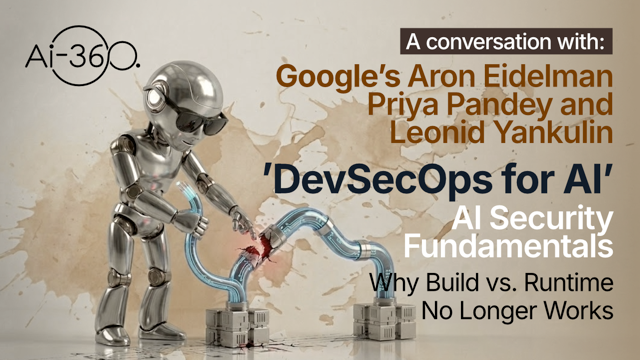
DevSecOps for AI: Why 90% Stays the Same—and the 10% That Changes Everything
Is your DevSecOps pipeline ready for AI—or just ready for the AI you tested last week? AI systems behave probabilistically. The same prompt injection attack can succeed 50 times in a row, then fail completely the next minute. Traditional shift-left testing was built for determinism. AI isn’t. That gap is where risk lives. Three members of Google’s security advocacy team break down what actually changes—and what doesn’t—when AI enters your DevSecOps pipeline. You’ll learn: • Why 90% of AI security is still traditional security—and exactly where the novel 10% creates new exposure • Why DevSecOps transformations fail within a year—and the top-down cultural shift that prevents it • How the latest DORA research shows AI agents amplify existing practices, good or bad, at scale • What AI runtime security (e.g., Model Armor) does that a WAF cannot • Why AI logs capturing PII and system instructions in plain text demand a new approach to observability Key topics: Non-determinism in AI testing • Continuous evaluation vs. pre-deployment scans • Model Armor & runtime security layers • Sensitive data redaction in logs • Prompt injection defense-in-depth • Agentic workload security • WAF limitations with AI agents • DevSecOps governance & top-down culture For CISOs, DevSecOps leads, and security architects navigating AI adoption: the pipeline you spent three years building is mostly still valid. This session tells you exactly what to add. All viewers will receive a c’heat sheet’ compiling links galore courtesy of Aron Eidelman.

Share this post
The link has been copied!