Nvidia has kicked off a month-long "Local AI" campaign highlighting new open-weight models and tools designed to run agentic AI directly on local hardware rather than in the cloud, the company said in a rolling blog series published from 11 August 2026.

Among the releases, Nvidia introduced Nemotron 3.5 Lightning, a 30-billion-parameter open mixture-of-experts model built for always-on agents, offering up to four times faster token generation than comparable open models. It also launched NeMo Switchyard, an open-source routing library that directs each step of an agent's workflow to the most cost-effective suitable model.

Meta released Muse Glimmer, a 30-billion-parameter model optimised for local coding and agentic tasks, capable of over 200 tokens per second on Nvidia's RTX 5090 GPU. Other partners including Poolside AI, DeepSeek, Alibaba and Thinking Machines Lab also shipped new open-weight models optimised for Nvidia hardware this week.

Nvidia separately updated its Sync application with a Cluster Assistant tool to simplify linking multiple DGX Spark systems for running larger models, and said DGX Spark will gain a native Chrome browser build and a new system resource monitor later in August.

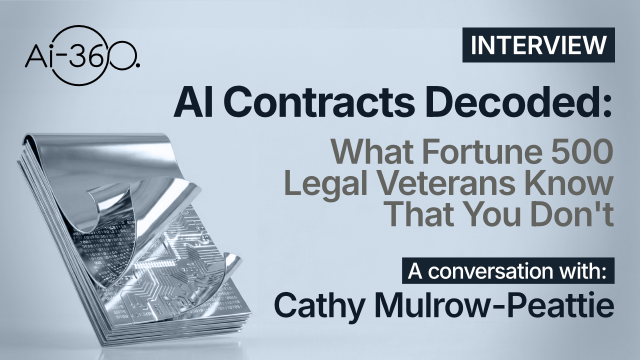
AI Contracts Decoded: What Fortune 500 Legal Veterans Know That You Don’t
When Microsoft refuses to negotiate indemnification with their biggest customers, what does that mean for your AI vendor contracts? When IBM data shows 97% of AI breaches stem from compliance failures—most being supply chain-related—who holds liability? When employees download shadow AI tools with zero cybersecurity controls, what recourse does your company have? None. Cathy Mulrow-Peattie brings perspective most outside counsel lack: Fortune 500 in-house experience at MasterCard and Omnicom, General Counsel at an AI startup, now advising enterprises. She starts with business goals before technology, technology before contracts—because she’s been in the hot seat when governance fails. You’ll learn: • Why 10-year AI contracts create risk and 90-day pilots with exit strategies are essential • The IP paradox: machine-generated outputs aren’t copyrightable but terms of use matter • How LLM providers retain “certain uses” of your data and when private instances become mandatory • Why contractual risk allocation to key vendors is your only viable strategy Key topics: Supply chain due diligence • The 97% compliance failure rate • Shadow AI liability traps • Benchmarking gaps • Hallucination disclaimers • GDPR/CCPA requirements • NY DFS Part 500 • Acceptable use policies • Dark web data sourcing • Evolutionary AI governance For: CISOs, CIOs, Chief Legal Officers, and compliance leaders navigating AI vendor relationships Contractual realities from someone who’s negotiated with Microsoft, advised Fortune 500s, and managed governance failures.
Share this post
The link has been copied!