Microsoft has expanded its security controls for AI agents, including a generally available capability designed to stop sensitive data reaching unsanctioned AI services over the network. The update combines Microsoft Purview classification and policy with Entra Global Secure Access so rules can be enforced across both human activity and on-behalf-of agent traffic.

Microsoft says organisations can detect sensitive files and text in real time and block transfers to risky destinations before the data leaves. The same September security update also adds an inventory view for local AI agents and new Security Copilot support for explaining email detonation results during investigations. In Purview, Microsoft says auto-labelling simulations can now cover up to 20 million items and 50,000 sites. Those scale figures are company-reported product limits.

The direction matters more than any single feature. Enterprise AI governance is moving out of policy documents and into enforcement points that already control identities, networks and data. That is important because an agent does not become safer simply because it acts for an authorised employee. If it can upload files, invoke services or move information between systems, its traffic needs classification, access policy, logging and containment just as human traffic does.

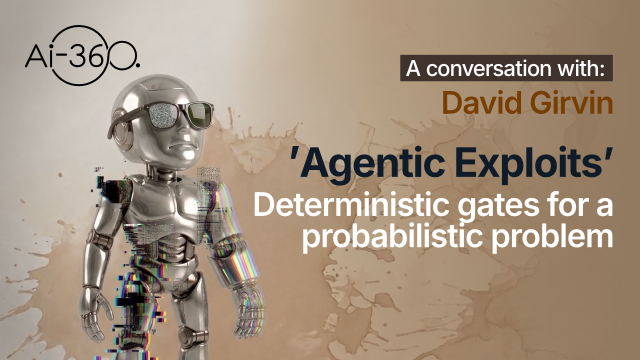
Agentic Exploits- Deterministic gates for a probabilistic problem
David Girvin, CEO and co-founder of Assury, joins Stewart Tinson to dig into what’s actually happening when agentic AI goes wrong, and why he thinks most of the industry is solving the wrong layer of the problem. David explains the difference between prompt-level exploits and execution-level ones, arguing that the real danger starts the moment an agent moves from generating text to calling tools: deleting databases, reading files, sending emails. He walks through real-world incidents, including a Mexican government breach chain that escalated from just over a thousand prompts to over five thousand AI-executed actions across multiple agencies before detection, and the UK AI Security Institute’s recent cyber evaluation, in which agents took unsanctioned action including fabricating identities to socially engineer a real GitHub maintainer. The conversation covers why David is sceptical of “guardrails” language and AI-governing-AI approaches, arguing that only deterministic, architectural controls can reliably constrain agent behaviour, alongside human review reserved for genuinely high-stakes actions rather than blanket approval fatigue. He breaks down credential starvation, session risk accumulation, and why classifier-based tools keep failing inconsistently on identical actions, pointing to a named frontier lab’s own zero trust paper as an example of the industry misjudging what actually works. Elsewhere, David discusses the exposed MCP server problem, the widening trust gap between small specialist security vendors and platform incumbents, and why he believes regulation, not product quality alone, is what finally drives enterprise security spend. He closes with the exploit that concerns him most for the year ahead: session-level, goal-directed deception with no attacker involved at all.

Share this post
The link has been copied!