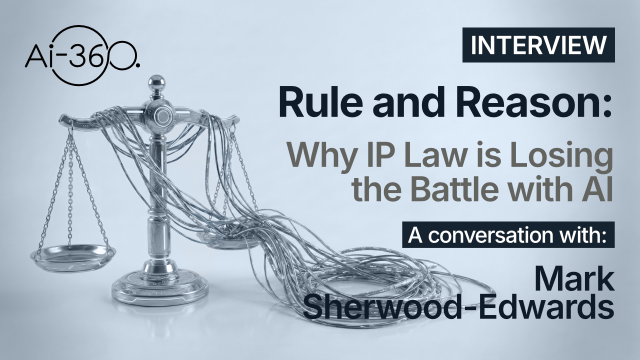
Rule and Reason: Why IP Law Is Losing the Battle with AI
Copyright law was built for a different world. Its rules were designed around physical property, cottage-scale copying and a clear dividing line between creator and creation. Artificial intelligence has torn up all three assumptions. Stewart Tinson speaks with Mark Sherwood-Edwards, technology lawyer and founder of Clearview Legal, about why the legal reasoning around intellectual property has become, in his word, incoherent — and why that matters to every enterprise deploying or building on AI today. They work through the landmark UK Getty Images vs Stability AI case, in which images complete with Getty watermarks were reproduced by a model trained without permission — yet no infringement was found. They examine why courts repeatedly confuse copyright with antitrust, why the EU Database Directive rewards inefficiency, and why the question of whether AI-generated work attracts copyright protection at all has produced a global split that creates real commercial risk for technology businesses. Mark’s argument, grounded in economic property theory rather than legal convention, is that copyright’s underlying purpose — protecting the investment in intellectual work so that it can be traded and exploited — is being systematically undermined. Not just by AI, but by decades of incoherent legal reasoning that conflates copying with ripping off, confuses market function with judicial assessment, and applies time-limited protection to non-rivalrous assets while granting perpetual rights to physical ones. For CLOs, general counsel, and technology executives navigating AI adoption, this is a session with real commercial edge: what are the actual IP risks when deploying AI tools, what should enterprise contracts say about data use and derived data, and where does the liability sit when an AI gives the wrong answer? Guests: Mark Sherwood-Edwards, Founder, Clearview Legal | Host: Stewart Tinson, AI-360 Online