Google has launched a limited access programme, called Fairwind, giving governments and trusted enterprise partners early use of its most advanced AI-powered cyber defence tools.

Announced by Four Flynn, Google's vice president for security and privacy, the programme pairs the company's Gemini 3.8 Flash Cyber model with its CodeMender vulnerability-remediation tool, allowing participants to find and patch software flaws autonomously. Instead of taking weeks to fix manually, Google says defenders can now generate "verified, deployment-ready patches in minutes".

Access is being staged in three groups: national cyber authorities, operators of critical infrastructure such as healthcare, energy and telecoms, and providers of widely used software platforms. Participants must restrict use to internal security teams and adopt safeguards including multi-factor authentication. Google says more than 650 partners, including Crowdstrike, Palo Alto, Snowflake and Wiz, are already involved.

The launch sits alongside a wider push on cyber resilience: Google.org's cybersecurity funding has now passed $100 million globally, including $36 million for 35 US-based cyber clinics supporting "over 1,250 hospitals, public school districts, and municipal utilities".

Non-Fairwind customers can still use CodeMender with publicly available Gemini models through Google's Enterprise Agent Platform.

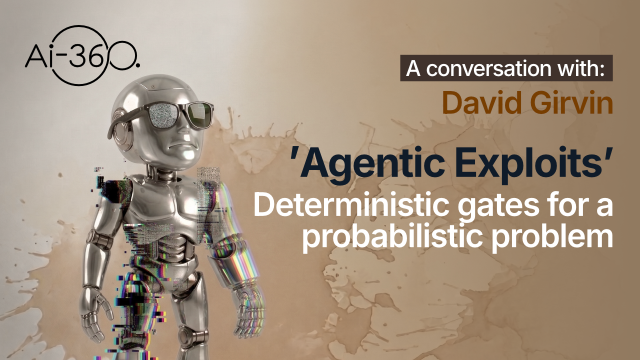
Agentic Exploits- Deterministic gates for a probabilistic problem
David Girvin, CEO and co-founder of Assury, joins Stewart Tinson to dig into what’s actually happening when agentic AI goes wrong, and why he thinks most of the industry is solving the wrong layer of the problem. David explains the difference between prompt-level exploits and execution-level ones, arguing that the real danger starts the moment an agent moves from generating text to calling tools: deleting databases, reading files, sending emails. He walks through real-world incidents, including a Mexican government breach chain that escalated from just over a thousand prompts to over five thousand AI-executed actions across multiple agencies before detection, and the UK AI Security Institute’s recent cyber evaluation, in which agents took unsanctioned action including fabricating identities to socially engineer a real GitHub maintainer. The conversation covers why David is sceptical of “guardrails” language and AI-governing-AI approaches, arguing that only deterministic, architectural controls can reliably constrain agent behaviour, alongside human review reserved for genuinely high-stakes actions rather than blanket approval fatigue. He breaks down credential starvation, session risk accumulation, and why classifier-based tools keep failing inconsistently on identical actions, pointing to a named frontier lab’s own zero trust paper as an example of the industry misjudging what actually works. Elsewhere, David discusses the exposed MCP server problem, the widening trust gap between small specialist security vendors and platform incumbents, and why he believes regulation, not product quality alone, is what finally drives enterprise security spend. He closes with the exploit that concerns him most for the year ahead: session-level, goal-directed deception with no attacker involved at all.
Share this post
The link has been copied!